Friday, August 5, 2011

Marley and Me by John Grogan - More Grogan than Marley, I'd Say..

Hey Rebel Readers!

Recently finished up Marley and Me by John Grogan. My mom sent me a copy last Christmas, telling me that the story reminded her of what I've told her about my Labrador's antics, and since Christmas she's been asking if I've read it yet. Well, mom, now I have =D Gotta say though, I'm a little bummed - the book was lauded as this stellar animal lover story but it just didn't reach that level for me. = ( I mean, the Grogans clearly loved Marley (most of the time) but damn, some of the sheer naive, almost negligent human behavior in this book stunned me!

"The Yellow Lab" by Dean Russo
See Dean's Etsy shop, 405 Poprocks,
with more of his artwork, here.
Amazing stuff!


For anyone that has not read this book, it is a work of non-fiction, in which newspaper columnist John Grogan tells the story of Marley, his Yellow Lab, a dog he deemed "the world's worst dog" (says so right on the front cover - see below:)


How bad can an animal with a face like that be? Well, I can tell you first hand - Labs are a handful! That face just makes it harder for you to really get that mad at them - you get steamed for about a minute and then you realize you're laughing at yourself and the dog because this Lab is looking at you like "Well, what did you expect - I'm a big bumblin' dog!" I'm serious, our Lab is 5 and most days she still has trouble working out a system where all her feet can go in the same direction, not to mention her infamous non-stop tail wagging, known to do record damage all on its own!


But back to the book - let me say I did enjoy the tales of Marley and his mischief, the problem for me was that there wasn't enough Marley in Marley and Me! I felt like I would get a brief, entertaining story about Marley and then Grogan would start rambling for pages on end about his work, he and his wife trying for a baby, his quest to find his perfect niche in life - that's all well and good but save it for an autobiography about YOU, or if you want to write a memoir - say it's a memoir about you with some funny dog stories thrown in (which is basically what this book felt like to me) instead of making it seem like it's 100% about the dog. 

Though for me, this book may have been more aptly titled "Me... and oh yeah, Marley" , when Grogan did talk about Marley, I was entertained, particularly with the history of the breed : what is now known as the Labrador breed dates back to first being recognized around the Newfoundland area (Canada) in the 1600s, near but not exactly in the city of Labrador, though the exact origin of the breed is unclear. They were later imported to Europe where in the 1830s the 3rd Earl of Malmesbury deemed them Labradors and the name stuck While discussing the history of the breed, Grogan touched upon something that I immediately recognized in our Lab, Morgan:


"Labs were bred as working dogs and tended to have boundless energy. They were highly social and did not do well left alone for long periods. They could be thick-skulled and difficult to train. They needed daily rigorous exercise or they could become destructive. Some were wildly excitable and hard for even experienced dog handlers to control. They had what could seem like eternal puppyhoods, stretching three years or more. The long, exuberant adolescence required extra patience from owners {that's for sure!}. They were muscular and bred over the centuries to be inured to pain, qualities that served them well as they dove into the icy waters of the Atlantic to assist fishermen {I had to train Morgan just to voluntarily get into the bathtub to wash her!} But in a home setting, those same qualities also meant they could be like the proverbial bull in the china closet. They were big, strong, barrel-chested animals that did not always realize their own strength." Ch. 3

Just an example of this exuberance, below is a short clip of our dog, Morgan, during the first snow of last winter:


Then there was the bit about being angry at Marley, and I instantly thought of the times we've had to scold Morgan for bad behavior:

"As was a hallmark of his breed, he was immune to pain, an unstoppable force of muscle and sinew {we call our dog "The Mo Tank"}. Once when I was in the driveway washing the car, he jammed his head into the bucket of soapy water and galloped blindly off across the front lawns with the bucket stuck firmly on his head, not stopping until he crashed full force into a concrete wall. It didn't seem to faze him. But slap him lightly on the rump with an open palm in anger, or even just speak to him in a stern voice, and he acted deeply wounded. For the big, dense oaf that he was, Marley had an incredibly sensitive streak." Ch. 15

There is also discussion in this book about Marley's aversion to the sound of thunder... another commonality with my own dog. As soon as the sound comes, Morgan instantly finds the nearest human and huddles with all her heart! In the book, Marley was more of an extreme case, going so far as to turn to destructive behavior to vent his unease.


scene from the film Marley and Me

Though I enjoy and appreciate the story of Marley (just Marley) there were a couple things that stood out about this book that really bothered me - even in the bits about Marley:

1) In a later part of the book, Grogan makes a huge deal about meeting a nice pit bull, stating that the breed is known for their aggression. Nooo - pit bulls are known for their intense loyalty and protective nature over their owners but are in fact very loving and gentle with responsible, loving owners. It's the jackasses that raise them to be violent that makes it seem like they are an aggressive breed. I'll tell ya right now, reading this book, you'll find that this guy really tends to "just wing it" in the research dept.

2) Okay, let me start with referring to these two excerpts that just incensed me:

Chapter 23, Page 232 (paperback edition here): "...we began freely supplementing his diet with table scraps, against the better advice of every dog guide book we had ever read. Table scraps, we knew, simply programmed dogs to prefer human food to dog chow... Table scraps were a recipe for canine obesity. Labs, in particular, were prone to chubbiness, especially when they moved into middle age and beyond." Okay, so he's learned that much, right?

Reading on to Page 233-34: " Each evening after we finished our dinner, when it came time to give Marley a meal, I would fill his bowl with chow and then freely toss in any tasty leftovers or scraps I could find. With three young children at the table, half-eaten food was something we had in plentiful supply {two words here: compost bin - oh yeah and this guy was editor for Organic Gardening Magazine}. Bread crusts, steak trimmings, pan drippings, chicken skins, gravy, rice, carrots, pureed prunes, sandwiches, three day old pasta - into the bowl it went {I cringe!}. The only foods we kept from him were those we knew to be unhealthy for dogs, such as dairy products {you can give dogs cheese in small amounts, you know - sometimes it serves as the only way to get meds into them! And you avoid giving him dairy, but pan grease, dripping, and chicken skins are okay???  Order of Coronary, Table 2!!}, sweets, potatoes, and chocolates. I have a problem with people who buy human food for their pets {what's the difference if you're just giving the dog your share??} but larding Marley's meals with scraps that would otherwise be thrown out made me feel thrifty - waste not, want not - and charitable. "

Yeah... Vets love getting "donations" to their "charity" when such pet owners end up having to pay to have their dogs treated for obesity and canine diabetes, just to name a couple problems that develop from this kind of behavior - Marley himself goes on to have serious stomach issues - wonder how "thrifty" Grogan felt paying that tab.

Denial is more than just a river in Egypt... 

There is also discussion of how Grogan freely lets Marley (even encourages him!) to come up the stairs in the dog's late years when he's battling severe hip dysplasia. I just wanted to slap this guy! There are sooo many things that could have led to less pain and trouble for this dog later in life. I'm not a perfect pet owner, I get mad and overreact at things at times, but I've raised animals all my life and I learned early on that you should reward a pet's loyalty by giving them the best, healthiest life possible - not give into indulgences (even though you know they can endanger the animal) just because you can't help yourself! This family was lucky to have a dog that was so loyal and loved them regardless but it just killed me that it could have been so much easier on him. 


Grogan and his lab Woodson, who was one of the dogs
 used to portray a young Marley
in Marley and Me


scene from Marley and Me

All this and the American Kennel Club actually went on to say (and I quote from an article off their own website) :

"Responsible dog ownership is something Grogan, the author of the best-selling book on which the film is based, knows better than anyone"

REALLY??? Better than anyone?? Did they read the same book I did? ' Cause those quotes about Marley's diet are Grogan's own words! 

Well that's enough of a rant for now - Marley and Me is a cute story for the dog antic tales (tails?) - don't avoid it just because I didn't love it. I always encourage people to find out for themselves. What's blah for me could be mind-blowing for you and vice versa. If you had a different interpretation on reading this (or any book discussed here) feel free to tell me! I'm open to all views, even if they do not echo my own - I like variety and debate! 

I've yet to see this movie in its entirety, but it's coming up on my Netflix so probably in the next few days - I'll let you know what I think ...

If you want to see a really funny review of the film Marley and Me, check this out!

If you are a Labrador owner and are interested in being part of an official club / community where you can mingle with other Lab lovers, there are a couple options for you :

~~~ The National Labrador Retriever's Club offers membership for $30 a year OR

~~~ The Labrador Retriever's Club, Inc. (the AKC Parent Club of Labrador Retrievers) offers membership for $15 a year.


Newfoundland dogs are cousins of the modern day Labradors - can you spot the resemblance? =)

Newfoundland dog


Pic of our Black Lab Morgan (taken a couple years ago) 


Sunday, July 10, 2011

Do Women Do It Better? : A Week of Lady Emperors!

This post is slightly belated, and was pushed over for my July 4th post but that doesn't mean it's any less special =)


So, my last book post was about Shan Sa's The Girl Who Played Go. This post, I am following up with Shan Sa's Empress, a fictionalized account of the life of Empress Wu Zeitan, a.k.a. "Heavenlight". The story has to be fictionalized mostly because as far as hard facts, only bits and pieces are known about the real woman, mainly due to the fact that one of her many power-hungry sons forced her to abdicate her throne, handing it over to him when she was in her seventies. He later had nearly any mention of her wiped from China's history.  A little more on that later...


Chiang Ping, China (once known as Long Peace)
the native land of Empress Wu before she entered the Forbidden City

Louyang, a province Empress Wu once ruled over

Louyang monastery

This woman, Wu, amazed me with how she was able to come from nothing, just happen to have a chance acquaintance with someone close to the Emperor, be inducted into the Forbidden City,  rise through the ranks of such an elite society and become such a powerful politician and respected ruler in her own right! Empress Wu came from very meager beginnings from an impoverished country family (who actually had a respected bloodline, just no wealth to it). She by chance happened to meet a political advisor to the Emperor when she was a child, who became charmed with her youthful curiosity and intelligence. She was recommended for entrance into the Forbidden City at the age of 13,  became accepted and entered at age 14. Her position was technically that of a low-ranking concubine but her official title was Talented One Wu. As far as the novel describes, Wu was never taken to the Emperor for sexual favors (perhaps because she was considered one of the less physically attractive concubines in court) but was instead invited into the Emperor's presence after he became impressed with her show of intelligence. 

Aerial view of the Forbidden City, home to Emperor of China

Forbidden City


When Wu was nearly out of her teen years, the Emperor died, leaving the thrown to a trusted son who actually didn't want the throne. As fate would have it, this son had been friends with Wu for years (the two of them being close in age) and had secretly been in love with her for some time. Through normal court rituals, the new emperor had been married years before (I think when he was 15-16 yrs old) and already had an Empress but he was still offering Wu the throne and anything else he could think of - even monogamy, which was an unheard-of practice for emperors in that day! Wu was interested but knew the stink it would stir up. Plus, there seemed to be a stigma attached to her technically being a concubine (even if this was never physically fulfilled) of the last emperor. She felt it would shame the new emperor for him to publicly show attention to his father's "sloppy seconds" in a way. Her solution is her joining a Buddhist monastery as a nun for 3 years, telling the Emperor that should he come for her in 3 years, her soul would be considered pure and no one could speak bad of him taking her back into the Forbidden City.


Wu goes through with her plan, and much to her surprise, at the end of three years, the emperor does come for her and asks her to return to the Forbidden City, his attitude being "to hell with what the Empress says!". Taking it one step further, he takes the liberty of impregnating Wu, and then saying, in so many words, "well, now you have to come back, you got a royal in there!" 

Wu and her emperor love return to the Forbidden City and set her up as the royal favorite (aka - back to being a concubine!) until after so many years some sneaky court shenanigans come to throw the emperor's wife and her lady in waiting off the throne, out of court and into the Cold Palace (by description it seems like this might have been the Chinese version of the Tower of London - lots of torture, starvation, and 'ooh oops they died while imprisoned' kind of stuff). Once Wu is made Empress Wu and gets involved in Chinese politics, she finds that this man she married is actually a pretty ineffective leader on his own. He admitted to never wanting the throne and apparently over the years never developed any interest other than for the ladies. That's right... Wu married a playa! (remember what I said about the monogamy thing back then... )

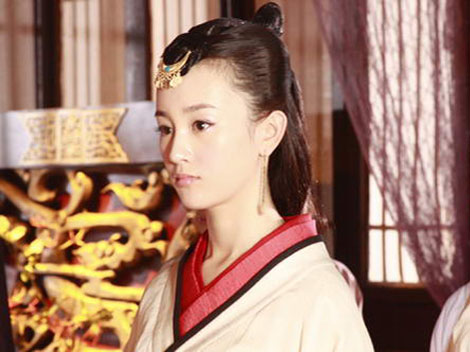
Alyssa Chia (Jia Jing Wen) as Empress Wu

Ru Yue Ling Kong
The Shadow of Empress Wu (2007)
Is anyone else reminded of Padmé Amidala?
 (Natalie Portman's character in the Star Wars prequel trilogy)

Empress Wu began doing her husband's job behind the scenes, having him sign off on her decisions (almost makes me wonder if we ever had a First Lady that secretly ran the country for her husband lol). This continued until his death until she was elected as the first and only full power female emperor in Chinese history (different from just being Empress through marriage - she was actually considered the Emperor after her husband's death). Her husband officially left the throne to one of his son's but funny enough, he left it to the one son that didn't want it! So the son passed the buck to his mom. Guess her son wanted the privileges of court life without the actual work lol. Empress Wu had a number of other sons who were "chompin' at the bit" but she didn't feel any of them showed qualities of an effective leader so she continued to rule herself until well into her golden years when one of her sons, nearing his senior years himself, got tired of waiting and just threw her out of her throne, sending her off to some distant palace outside of the Forbidden City. Wu's response was essentially "I'm not sure how impressive it is - stealing your throne from a defenseless old woman." Wu was then forced to sit back and watch her son systematically destroy decades of her hard work in a matter of a few years. Her son was a bit bitter about having to wait so long to throw around his power, so he had his mother's name erased from historic scrolls, had her temples, shrines and monuments destroyed, and essentially tried to make himself and everyone around him forget she ever existed. Pretty cold-blooded, huh!

from the 1963 film Empress Wu


"Every woman in the Forbidden City -- beautiful or ugly, intelligent or foolish, refined or vulgar -- was fragrant dust. The whirlwind of history would carry them away, making no distinctions." 
Empress Chapter 4 pp86-87

Reading this book had me imagining a woman that must have had an amazing presence! She was quiet and as fair-minded as possible, but could be cold-blooded when she felt threatened (even having some of her own family executed simply to show she did not show favoritism when it came to upholding the law - wrong is wrong). She was not known for being a stellar beauty but clearly had magnetism, in a way that both men and women responded to. She loved using her feminine power but like any other woman was ever fearful of her body losing its allure. She worried about her weight, wrinkles, keeping up with the younger girls at court. Yet, at the same time she had a powerful lust for life and the afterlife, knowledge, just being a part of everything. She commissioned the building of a massive Buddha statue still in existence today, and climbed Mt. Song in her seventies!

"Why does the body shrivel and dry, when the soul, this fathomless voice, still longs to flourish? Why did anyone invent mirrors to glorify and assassinate women? Why should I, Emperor of the Zhou Dynasty, Master of the World, a Divinity on Earth, be obsessed with my ephemeral form? And why should I, who knew celestial beauty, still strive so desperately to look after my earthly face? Why should I choose this torture when I aspired to deliverance?"
Empress Chapter 13 pg 291


The Buddha Empress Wu had built for her people


Mt. Song
Right before her death, Empress Wu wrote her epitaph, spelling out what she wanted written on her royal monument. After her death, her son, the emperor, did not agree with what she wrote, but could not decide on any sort of wording himself, so her stone monument was famously left blank - something that can still be seen to this day (the only emperor in history to be left with this void after their death). 

Empress Wu's blank stone monument

Etchings on Empress Wu's sarcophogus

"Heroes are damned. No mortal conquers death." 
Empress Chapter 4 p 87


The story of Empress Wu reminded me of the struggles of Queen Elizabeth I, having to push past established gender roles, to go on to be one of the most effective leaders in history. While Elizabeth I had similarities, Empress Catherine of Russia's life was eerily parallel to Empress Wu of China! Both were married young to men they soon found to be puppet-leaders. They both took it upon themselves to rule their countries secretly until opportunity came about to rule as the officially accepted leader. They both had to face the disappointment of mothering children that were nowhere near being suitable to manage a country's throne.  If you like stories of powerful women, court intrigue, rising above the inconveniences that life places in front of you - the biographies of both these women are not to be missed. Not to mention the fact that Empress is just one of those books you want to live in simply because of Sa's stunning talent for creating environments!

By the way, I recently saw a pretty interesting documentary done by PBS called Catherine the Great


Also, though I don't think it is specifically attached to this documentary, there is a book I read that really parallels the sequence of events in this documentary, making it a good companion piece - the biography Great Catherine: The Life of Catherine The Great, Empress of Russia by historian Carolly Erickson.


Next post I'll be discussing some military / patriotic inspired reads in honor of the month's holiday. Stay tuned!


Saturday, June 18, 2011

The Girl Who Played Go by Shan Sa - REAL Teenage Strife!

With the book market being flooded with novels about angsty, twinkly vampires and kids struggling with getting picked on, it's refreshing (though heartbreaking) to find a book like The Girl Who Played Go that makes modern day emo kids look like whiny babies that just need a nap!


Chinese author Shan Sa (real name Yan Ni)
Sa has spent much of her life in France, writing her novels in  French.
Adriana Hunter has done the English translations for a number of Sa's novels.

The Girl Who Played Go by Shan Sa is actually the combination of two stories being told simultaneously (the chapters alternate between the two telling their stories in first person) of a male Japanese soldier and a female Chinese student and "go" player in 1930s Manchuria. Their stories take place just before the start of World War 2 when Japanese forces invaded the Chinese territory of Manchuria. Neither reveal their names til the very end of the story, which I found to be an interesting little quirk in the novel. The back and forth story switches between chapters wasn't as hard to follow as I've found in other novels, and Sa's writing is so poetic I found myself not really minding keeping up with the two individually.

Japanese invasion of Manchuria 1

Japanese Invasion of Manchuria 2 
At the beginning of the story, the anonymous girl leads a pretty ordinary teenage life - she goes to school, finds her parents annoying and controlling, tells secrets to friends, crushes on boys, reads the 18th century Japanese poet Issa, and plays go (a game similar to chess or checkers) in the park. In playing go, she has her greatest outlet. She is unique in that she is the only female in her community that is part of the local professional go players group. She finds peace in the concentration required for the strategy-based game. It gives her a place where she doesn't have to think about war, her sister's unhappy marriage, her bland parents or what will come of her own life with the Japanese invasion. But as often happens in reality, you never know who life is going to throw your way when your world gets turned upside down. With the Japanese invasion comes Chinese rebellion and into go girl's life walk two boys,  Jing and Min, who are leaders in the rebellion. Of course girls are drawn to rebels so go girl develops "a thing" for Min while putting Jing in "the friend zone", which he gets pretty peeved about.

The game of Go

Go patterns can vary


My favorite quote in this novel :


"You see," she (Huong, best friend of go player) says, "a real man is different, not like the boys with mustaches who lurk outside our school. He can guess what you're thinking, anticipate what will make you happy. When you're with a man, you're no longer a girl but a goddess, a sage, an ancient soul who has lived in every era, a wonder that he contemplates with all the intense curiousity of a newborn baby." 


To which go girl's internal thought is:


"Even though Huong has become my best friend, I never quite understand what she is saying. Her convoluted soul is divided between light and darkness, she is both blatant and discreet, and her life is full of mysteries despite everything she confesses to me."


How many of us have known someone like that, right?!

While go girl is working out her conflicted teenage girl hormones, slightly older Japanese soldier boy is telling his story of being a survivor of the 1923 Kanto earthquake (one of the worst earthquakes in history) in which he lost a number of family and friends. 
Villages demolished by Kanto earthquake

Emperor Hirohito viewing the damage from the Kanto earthquake


He grows up to become a soldier, following the common soldier life of marching, practicing marksmanship and visiting "houses of ill repute". He does have a brief love interest with an apprentice geisha -- the geisha's mother approaches him to offer her daughter's mizuage to him. Mizuage is the "deflowering" process each virgin geisha apprentice or meiko must go through before they are deemed a full-fledged geisha or geiko. To be offered a mizuage is considered a great honor for men and traditionally a rich man would pay a hefty fee to be assured his right to the girl but soldier boy is offered it because the meiko's mother wanted to assure her daughter a relatively painless, gentle mizuage.


Speaking of geishas, there are ways (in the form of outfit) to tell the apprentices from the full-fledged geishas, which they discuss in this book. One way is to look at the sleeves of the kimono. Meikos (those still in training) wear wide sleeves and often more ornate collars, while geikos wear more narrow sleeves and more subtle print kimonos.


MEIKOS:


GEIKOS:


When not visiting geishas, soldier boy takes his business to local prostitutes. Contrary to popular belief, geisha is not synonymous with prostitute, though sex can be part of an evening with a paying gentleman. It's actually more of an opportunity to share company with a woman heavily educated in arts such as literature, music, painting, tea ceremonies - skills not taught to the common woman. Because of this education, geishas have a higher price than run of the mill prostitutes, thus not commonly affordable on basic soldier pay, but boys can save up I guess! The prostitutes of the 1930s typically wore fashions of the period instead of the traditional kimono. 


As go girl works through her dramatic relationship with Min, soldier boy draws closer to her when he is asked to do a little espionage work, dressing as a Chinese man and playing go games with her in the park, in the hopes of garnering information to take to his superiors. This part confused me because I'm not sure what big secrets he thought he was going to find out from a random teenage girl that would help out the Japanese government ... and he later points this out himself. Through their games though, they develop a bond that is confusing but undeniable to both of them, and so the story develops into a tense, almost love story between people on opposing sides of the war. Amidst all the drama tearing their countries apart with newsmakers such as Chiang Kai-Shek and Emperor Pu Yi, they try to figure out what it is they feel, what draws them together, and how they can possibly make it work... with one HELL of a surprise ending... it's a resolution of sorts, but daaaammnnn lol.

Chiang Kai-Shek Memorial

Chiang Kai-Shek and wife May Soon Ling

Emperor Pu Yi and Empress Wan Rong

When soldier boy and his comrades aren't trying to work through their big boy hormones, there's a lot of talk about seppuku (also called harakiri) in the event that Japanese success in Manchuria doesn't come to full fruition. I am always amazed in the "all or nothing" attitude - there's so many areas of grey in life but some people still insist on the "if you're not 1st you're last" motto. Freakin' Ricky Bobbys of the world! :-P.


While Sa's writing skill is stunning, the story itself is not an easy one to read, but one I think needs to be read.  It feels sometimes as if in times of war we forget about the young kids that have to survive it. This gives an interesting perspective on such a situation and takes "coming of age story" to a whole new level! 

While I don't want to reveal the characters' names, as that is one of the powerful elements to the story's ending, I will give you a hint to the girl's name:


Have fun guessing! :-)